"I'm the first to pitch about DST, not because I have trouble getting up, but because of the whole idea! Anyway, it was snowing yesterday, covering up all the mud and ugliness in the backyard and around the house. It wont stay for long. Cleanup is such a mess, I think I don't like March." End of whining.
To cheer me up, I made my tea pot a dress. O.K. it's ugly, so ugly like an ugly child only a mother can love it, but it's doing a terrific job! Some time ago,
Claudia put the idea into my head, and suddenly, one day, it became very clear - I NEEDED a tea cosy really bad. Watch out, pots and pans, I'll cover you all over time. I'm afraid as time goes by, my house, and it's contense will be covered in knit wear eventually. Somebody help me, please! :o)

So, the tea pot cosy is actually called "tea mitten" by
Elisabeth Kleven, and it appealed the most to me, when I searched for a pattern. I liked the name too.
Not every tea pot is built equally, as I had to find out the hard way. I picked the leftover yarn, hm why exactly? I guess I wanted to see how it looked knit up, and I wanted to knit with my handspun yarn, and as a leftover thingy it shouldn't disappear in the big black hole of a handspun yarn holding bin. Not that I really need a reason for picking any of my handspun, but I always think, the REAL handspun yarn, the one I intended to look like it does, is meant for something grand, something special, and this tea mitten is destined for everyday life, nothing glamorous about it at all. Since it's been finished and used for some time now, I can tell you it does a terrific job in keeping my tea warm longer. I didn't expect it to work, never used a tea cosy before. It's a positive thing, I like it. Maybe some day my tea pot will get a new Sunday dress, in real nice yarn - maybe.
It should have been easy and quick to knit this mitten, but it was not. I had big trouble with gauge. Who would knit a swatch for a tea mitten? I was stumped by row 9, asked for help, got it, but couldn't wait for it, so I did my own thing, which turned out to be right anyway. I knit on very enthusiastically, only to discover, that I ran out of yarn about 10 rows before the finish line. With a sigh, I put it aside, to rip it out the next day. It was late, I wanted to take a picture to show you a failed project for once (you don't get to see all the ones I cast on and rip out again, and there are many).
Next day, I had a light bulb moment. I took the almost finished mitten and put it on my tea pot. Wouldn't you know it, it was WAY to BIG! What did that tell me? I did indeed have enough yarn to make this tea mitten, because I had to custom fit and knit it. Yeah! I ripped it out, without taking a picture, who needs it, it will be O.K. after all!
Well, to make a long story short, it was much easier to knit it the second time, and even easier to make modifications to fit the pot. Only I forgot to pay attention to the snout of the pot. The gusset is a bit wide for it, but I didn't care at that point. Everything else fit's like a - mitten.
After finishing it, I washed it, and put it on the tea pot wet, so it could dry form fitting, and it did. It slides off an on so perfectly. I'm glad I made it, just wished I had used nicer yarn. A word about the yarn. When I spun this yarn, I had a 4-ply in mind, and as you might remember it turned out very well. But there are always left over singles, which when enough, I navajo ply most of the time. So this yarn was the product of such a situation. It would have striped nicer if knit entirely in the round, as the first few rounds, and the last several rounds as well, but the main part was knit back and forth, and that's the reason why it did what it did. Oh well.
Well, enough of the tea mitten, lets get the tea poured already! Ah, it's hot, hot, hot!
 specifics:pattern:
 Tea mitten by
Elisabeth Kleven,
ravelry link (I don't think you can get it anywhere else)
yarn: handspun Santa & Candy Cane leftover, navajo plied, 87yds
needles: 3.5mm DP
notes: cast on 72 sts., made some mods to fit my pot
start-finish: February 15-16


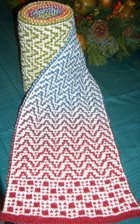
 I even find the wrong side attractive. The fun here is, that you can choose different weight yarns, and it still looks good, but you don't have to. Katia Mexico is slightly thinner as Gedifra Fashion Trend, but not very much noticeable. I'd like to try totally different yarns together some time. The edges are not very pretty, don't know if it's just me. I'd love to knit another scarf, but I think I'll try some socks first, or something else from the book, but a small project for sure. (I just finished a second sweater for Hannah, pictures comming soon).


 When you click for a close up look, you can see the fuzziness of the mohair. I just love that.